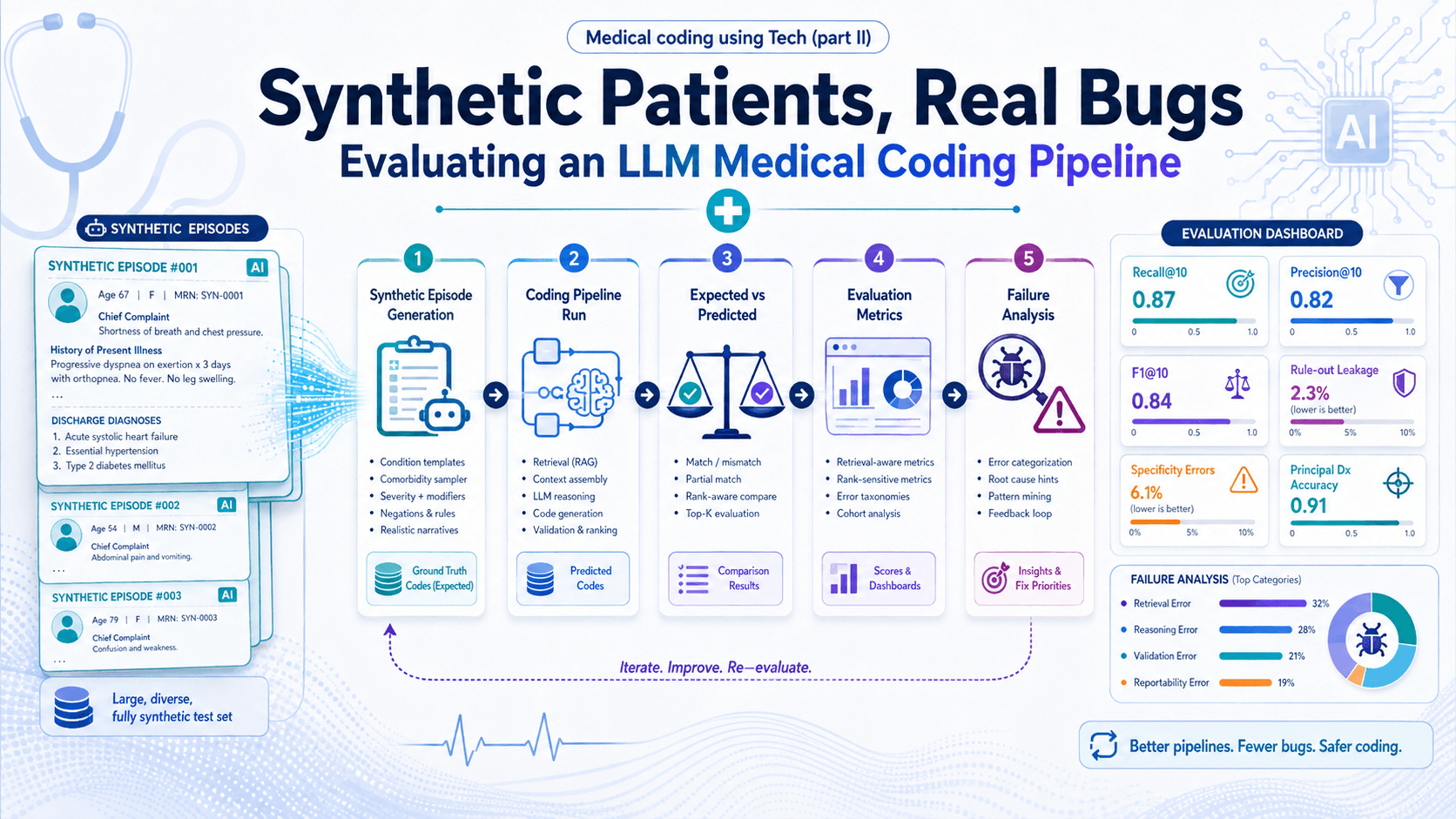
There is a particularly dangerous phase in building an LLM system.
-
It produces an answer.
-
The answer looks correct.
-
You celebrate.
-
Then you try 100 examples
-
You suddnely become miserable
This cycle can happen in eleven minutes or in eleven days .
Medical coding systems expose this cycle brutally because errors often look perfectly respectable: for example
Acute kidney injury
→ Other acute kidney failure
Looks interchangeable.
But if the documentation contains no subtype, the result may be overly specific.
Another example:
Obesity
→ Class 1 obesity
Both conditions look similar
But where did class 1 come from? Nowhere.
Here the model has invented specificity on its own.
Build evaluation set before polishing the demo
It makes perfect sense to treat synthetic episodes as first-class engineering assets in an LLM pipeline.
For evaluations Instead of one giant hand-written integeration test, It is wise to generate benchmark episodes in varying degree of difficulties such as:
Easy
explicitly documented conditions
sub conditions
ruled-out conditions
Medium
several diagnoses
chronic conditions
history
negation
symptoms
and eventually:
Hard
multiple related conditions
complications
acute-on-chronic disease
sequencing requirements
Similar ICD candidates
The goal isn't to pretend synthetic data equals hospital data. The goal is to create deterministic regression pressure.
A useful episode fixture then could be
DISCHARGE DIAGNOSES

Acute kidney injury secondary to dehydration.
Dehydration.
Chronic atrial fibrillation.

HOSPITAL COURSE

The acute kidney injury was attributed to dehydration. IV fluids were administered and renal function improved.

Chronic atrial fibrillation remained rate controlled.

There was no evidence of acute myocardial infarction.

PAST MEDICAL HISTORY

Previous ischemic stroke.
expected active output would be:
Acute kidney injury Dehydration Chronic atrial fibrillation
Dehydration
Chronic atrial fibrillation
but NOT:
Acute myocardial infarction
Previous ischemic stroke as current disease
Above fixture tests:
assertion
chronicity
causal relationship
active vs history
negation
candidate retrieval
specificity
which is arguably more useful than:
Input: "AKI"
Expected: N17.x
Measure the pipeline by stage
One overall accuracy number doesn't tell you much.
Suppose the expected code is:
N17.9and the system returns N20.1 .
Anything along the way could have failed?
Extraction
    ↓
"AKI" wasn't detected

Retrieval
    ↓
N17.9 never entered Top 10

Compatibility
    ↓
N17.9 was incorrectly rejected

Reasoning
    ↓
correct candidate was present but another was chosen

Reportability
    ↓
correct code was selected then removed

Sequencing
    ↓
correct codes, wrong episode structure
All of these are completely different engineering failures.
So a correct evaluation function should say:
CANDIDATE_RETRIEVAL_ERRORinstead of:
wrong codingRecall@K matters enormously
For retrieval, the first question is not:
Did the retriever rank the correct code first?
It's:
Did the correct code survive long enough for reasoning to see it?
So measure:
Recall@1
Recall@3
Recall@5
Recall@10

*If Recall@10 is poor, your LLM reasoner cannot save you.
It can't choose a candidate it never received.
Then measure false-positive behaviours
Medical coding needs metrics beyond conventional accuracy.
Some of the most useful regression metrics are:
Ruled-out active-code rate
Historical-condition leakage
Unsupported-specificity rate
Wrong-core-disease rate
Duplicate-code rate
Symptom overcoding rate
These often reveal more than overall F1.
Imagine accuracy goes from:
78% → 81%but unsupported specificity doubles. That's not necessarily a progress.
Synthetic episodes are excellent for adversarial testing
You can deliberately create cases like:
No evidence of bowel obstruction.and assert:
Bowel obstruction must never become active.Or:
Chronic atrial fibrillation remained rate controlled.and assert:
chronic != historicalOr:
Obesity.and assert:
do not invent class 1 / class 2 / class 3These aren't trying to mimic population prevalence. They're trying to attack your architecture.That's exactly what a regression dataset should do.
Generate cases, but don't let generation grade itself
There's an obvious trap with using one LLM model:
LLM generates episode
LLM generates expected code
same LLM evaluates model
Congratulations, it's an overrated echo chamber.
A better workflow is:
Synthetic episode generator (A different LLM)
      ↓
Expected labels
        ↓
Validate code against authoritative ICD database
        ↓
Freeze fixture
        ↓
Run pipeline
For a serious benchmark, human coding review should eventually enter the loop.
But synthetic datasets are excellent for early architecture development because you can cheaply generate hundreds of controlled scenarios.
Efficiency also becomes measurable
Once you have hundreds of episodes, you can study:
Average retrieval latency
LLM calls per episode
Tokens per episode
Abstention frequency
Candidate-set size
Cache effectiveness
Now you can answer engineering questions like:
Do we actually need 20 candidates?
Maybe Recall@10 is nearly identical to Recall@20.
Does semantic retrieval help?
You can compare:
Index + BM25against:
Index + BM25 + semanticIs the expensive reasoning model worth it?
Run the same frozen benchmark against several local models. That's a real scientific experiment.
A benchmark changes the conversation
Before evaluation the conversation starts with:
“The pipeline seems pretty good.”
After benchmark it pivots to:
Retrieval Recall@10: 96%
Exact code accuracy: 81%
Unsupported specificity: 7%
Ruled-out leakage: 0.4%
Now you know which direction to take further
And more importantly, you know when a fix introduces regression.
In the final article, I'll move from individual diagnoses to the harder problem: coding the episode itself : Reportability, principal diagnosis and sequencing without turning the system into a collection of medical
ifstatements with nested LLM calls .